Gore flood infrastructure upgrade
The Gore flood infrastructure upgrade, completed in April 2024, strengthens the town’s flood infrastructure network, improving performance for Gore’s ~7,300 residents and supporting key road and rail links between Murihiku Southland and the rest of the South Island.
In February 2020, very high flows in the Mataura River pushed Gore’s flood banks close to capacity, prompting the evacuation of more than 2,500 residents. The banks performed as designed but required significant repairs. This upgrade focused on the highest-risk sections to restore and improve service levels and reduce near-term flood risk.
Key upgrades completed
The project included constructing a flood bank along Ontario and Toronto Streets, upgrading stormwater culverts and removing high-risk trees along River and Richmond Streets to reduce flood risk. Re-grassing and earthworks were also completed to reinforce the new bank sites and prevent erosion.
Why these upgrades matter
Removing trees and shrubs on and immediately adjacent to flood banks reduces the risk of roots weakening the structure and of windthrow ripping out root balls that leave holes or gaps in the bank. It also lowers the chance of woody debris damaging infrastructure during floods. The upgraded flood banks are built to allow potential future height adjustments, helping sustain agreed levels of service over time.
Benefits
- Improved performance to the current design standard for Gore’s flood banks and related assets, reducing risk to people, property and critical services.
- Designed for future adaptation, so the works can be adjusted as climate pressures and service-level needs change.
- Co-funded with central government (Kānoa), bringing work forward from the Long-term Plan and lowering costs for ratepayers.
Funding
This project is part of the national Resilient River Communities initiative — a joint programme between Kānoa and Te Uru Kahika – Regional and Unitary Councils Aotearoa. It is one of Environment Southland’s RRC projects, delivered with central government co-funding during 2021–2024.
Looking ahead
On 16 October 2025, new co-funding was confirmed through Kānoa – the Regional Economic Development & Investment Unit (MBIE) under the national Resilient River Communities initiative. This supports the next phase: the Mataura River Flood Resilience Project.
This phase applies 2D hydraulic flood modelling across the Mataura River—including the Gore reach—to assess the capacity and performance of the existing flood infrastructure network, identify priority improvements, and inform an integrated, whole-of-catchment plan.
Alongside engineered works, the plan will consider nature-based measures where they add value (e.g. wetland restoration, detainment bunds, floodplain reconnection, riparian planting) to help slow, store and safely convey water while supporting ecological and cultural outcomes.
Building on insights from Murihiku Slow the Flow, the plan will test how engineered and nature-based measures can work together to reduce flood impacts. Nature-based measures such as wetland restoration, detainment bunds, floodplain reconnection and riparian planting can help slow, store and safely convey water while supporting ecological, cultural and community outcomes.
Insights from modelling and community engagement will guide the design and sequencing of future flood infrastructure works and longer-term adaptation options.
Related story: Family ties and living with the Mataura River
This April 2022 Envirosouth article shares how Environment Southland councillor and current Chair Jeremy McPhail and former Gore District councillor Richard McPhail talk about their lifelong connection to the Mataura River, the importance of looking after flood banks as shared infrastructure, and what the 1978 and 2020 floods taught the community:
Family ties, flood protection and building community resilience.
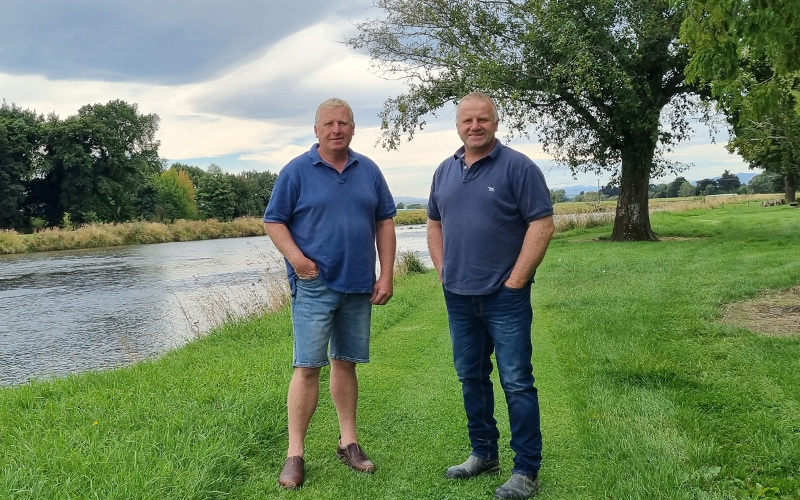
Richard McPhail (left) and Jeremy McPhail (right) grew up with the Mataura River and remain conscious of how closely their communities are connected to it. The brothers are sixth-generation descendants of the original 22,000-acre leaseholders of Merino Downs in the Waikaka Valley, northeast of Gore.