


Delving into the hidden life beneath the water’s surface
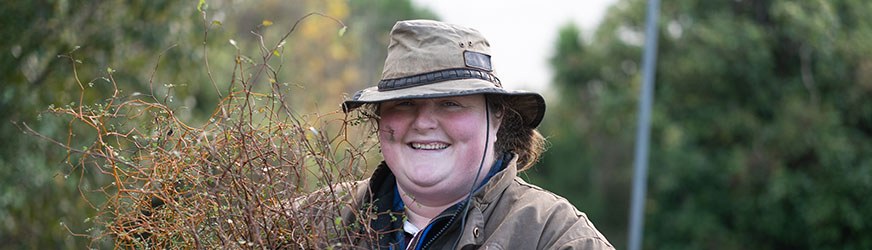
Kelsi Hayes with some of the seedlings from the Waikawa Community Nursery.
With her waders on and a kākahi freshwater mussel shell in hand, Kelsi Hayes is part scientist, part environmentalist, and wholly committed to the land and waters that raised her.
Growing up in Progress Valley, in the Waikawa catchment, Kelsi’s connection to the land runs deep. The second eldest of a sheep farming family with four siblings, she grew up helping on the farm, playing in creeks and, of course, joining in on the musical stylings her family is known for.
“We do make a terrible racket,” she says.
The Hayes’ have lived in Progress Valley for generations, their roots intertwined with the forests once felled by their ancestors.
“There’s a story that one of them said, ‘If you want to court one of my daughters, you’ve got to fell an acre of bush first.’”
It’s a tale told with a laugh, but it underscores a legacy that Kelsi is now working to balance.
“I guess when we talk about my ancestors cutting down all the trees,
I probably need to do a wee bit of something to settle that balance,” she says.
“It would be really bad if in a hundred years we’ve lost these things – kanakana, kākahi. Just because we didn’t care enough.”
So now Kelsi’s doing her PhD in Zoology at the University of Otago, studying kākahi, New Zealand’s native freshwater mussels. These unassuming creatures are more than just riverbed dwellers, they are indicators of ecosystem health.
“When you’re doing a PhD, it has to be unique science. Nobody’s really studied freshwater mussels, so it’s easy to get the tick.
“But it’s more than that. I love mucking around in rivers and creeks. It’s pretty fun when your job is playing in a creek.”
Her passion for freshwater ecosystems is matched by a pragmatic approach. “Freshwater mussels are particularly easy to study because they don’t move very far,” she says. “It’s half part intelligence, half part laziness.”
There’s no laziness in the approach though. Her research spans from the macro – the climate, geology, and geography, to the micro – where she examines the exact substrate stability of a streambed to understand where kākahi thrive.
Her plan is to collect e-DNA samples, conduct social science interviews, and dive into historical data to map where these mussels once lived and why they may have disappeared.
“I love mucking around in rivers and creeks. It’s pretty fun when your job is playing in a creek.”
She’s now looking for Southlanders who have done e-DNA testing in their creeks to share their data with her and for any anecdotal information on areas of the region where kākahi used to be but no longer are.
Kelsi’s life is a blend of science and community, of fieldwork and music.
She volunteers at the local museum, plays banjo with her dad, and shares stories that are as much about people as they are about place.
Whether it’s helping with a neighbour’s unconventional funeral or chatting about one of the many other projects she’s a part of, Kelsi’s world is rich with connection.
“You want the environment to be healthy because if the environment’s healthy then we get a bit healthier too. We’re all connected,” she says. “We can’t exclude ourselves from the environment and think we can live in a concrete place with no ecosystem. It doesn’t work.”
As one of the members of the Waikawa Community Nursery, she’s working with the group to provide accessible and ecologically suitable native plants for the area. Simply put, the aim is to restore the riparian margin along the Waikawa River and therefore improve the river itself and the indigenous biodiversity values of the catchment.
Formed earlier this year, the group is a way for locals to learn to propagate plants, learn about the environment and to keep connected.
For Kelsi, environmental work isn’t just about data points. It’s about ensuring that future generations can still play
in creeks, find eels, and marvel at the hidden life beneath the water’s surface.
“You want the environment to be healthy because if the environment’s healthy then we get a bit healthier too. We’re all connected,” she says. “We can’t exclude ourselves from the environment and think we can live in a concrete place with no ecosystem. It doesn’t work.”
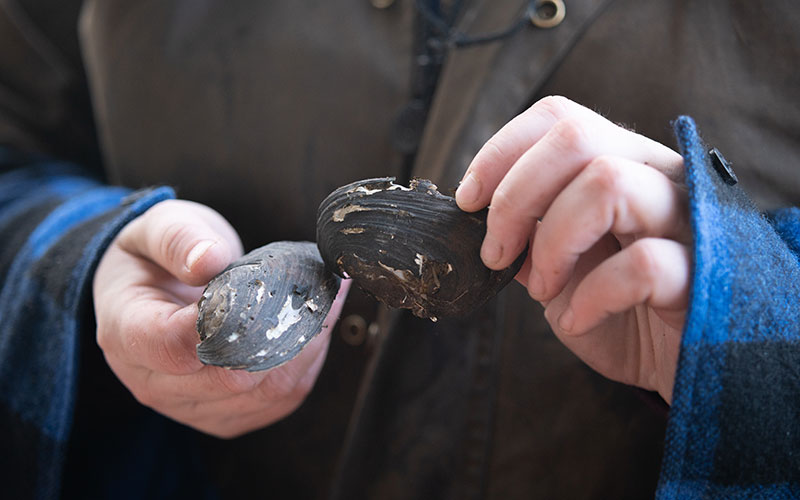
Kākahi (native freshwater mussel) shells.


